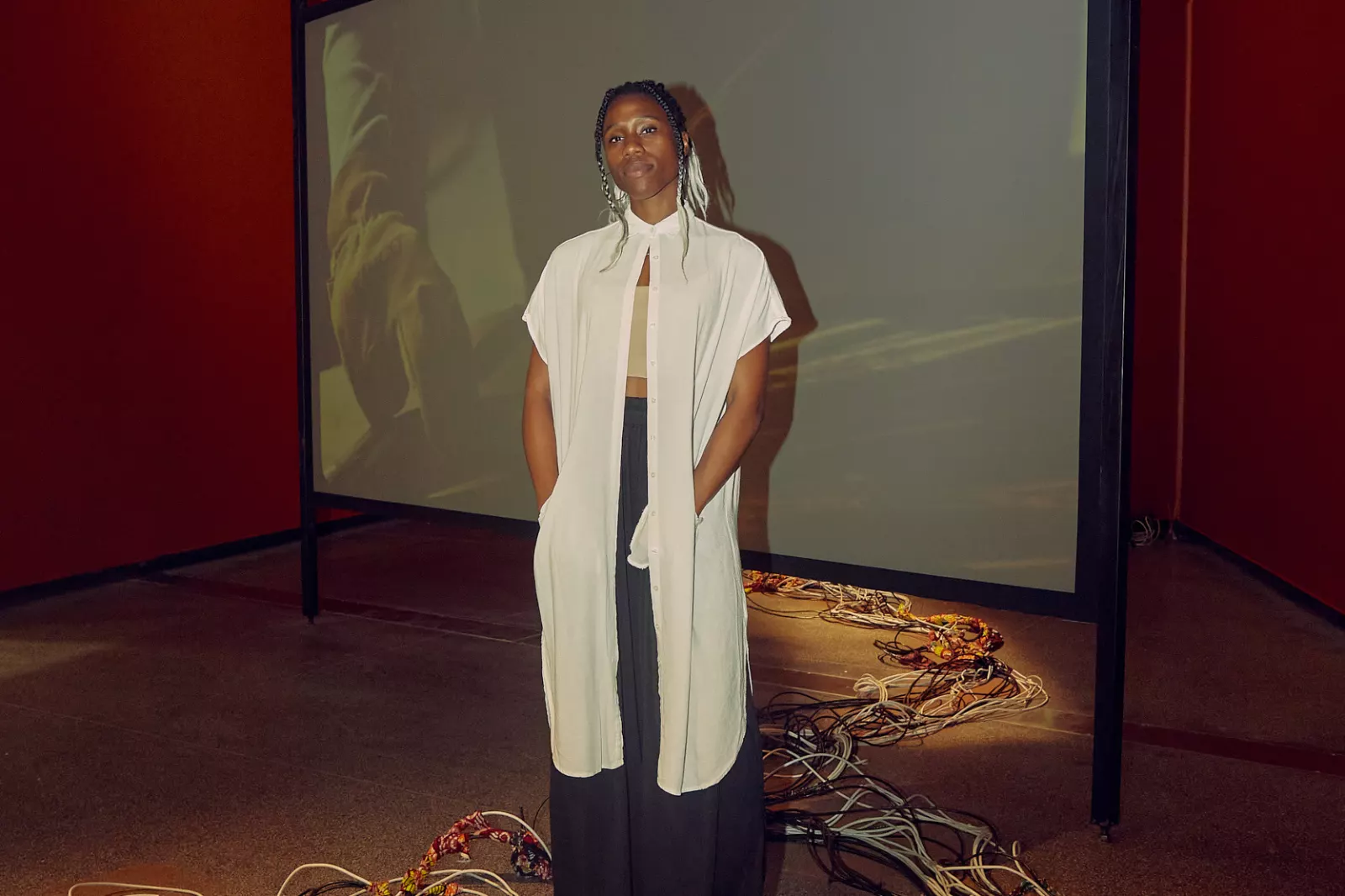
Mimi Ọnụọha
Biography
Mimi Ọnụọha (b. 1989) is a Nigerian-American artist based in Brooklyn, working across print, code, data, video, installation, and archival media to question and expose the contradictory logics of technological progress. Her work treats absence as a lens, focusing on the gaps that define systems of labour, ecology, and relations. Her solo exhibitions include Secession in Vienna, the Victoria and Albert Museum in London, and bitforms gallery in New York, and her work has been presented at the Whitney Museum in New York, Gropius Bau in Berlin, La Gaîté Lyrique in Paris, and the Australian Centre for Contemporary Art in Melbourne. A United States Artists Fellow and Creative Capital grantee, Ọnụọha also co-founded A People’s Guide To Tech, an artist-led organisation producing educational guides and workshops around emerging technologies.
Residency project
Principal Residency Program — 2027
At La Becque, Mimi Ọnụọha will investigate absence as an epistemological structure, taking as a starting point a mass grave in her hometown that remained unknown to the community for over a century despite ample clues to its existence. In an age of over-computation, the project considers how proof can fail not because evidence is missing, but because some truths exceed what a given structure can hold. Extending her longstanding investigation into technology and nature as ordering systems that both produce forms of unknowability, Ọnụọha will use La Becque’s garden as a site through which to materialise these absences and explore the new forms of unknowing produced by her own displacement.
Residency report
Eyebeam — 2020
During her 2020 residency as part of the Eyebeam Rapid Response for a Better Digital Future program, Mimi Ọnụọha developed the first phase of a research project examining the relationships between surveillance capitalism, racial violence, and systems of power in the United States. Starting from the understanding of surveillance capitalism as an extension of broader structures of domination that disproportionately affect Black, brown, Indigenous, and other communities situated outside dominant fields of power, Ọnụọha worked with a team to create an original dataset connecting histories of land and racial violence across the United States. Through this research, she explored how data can both reproduce existing power structures and serve as a means of making their underlying histories and social relations visible.
See also
Rebecca Kressley

Chaos Clay

Yen Chun Lin & Gediminas Žygus

Günseli Yalçınkaya
Iris Touliatou